Why Auditors Don't Want Your Raw Logs: Building Audit Reports People Can Actually Read

Every audit season, the same scene plays out. A security team exports a mountain of raw logs, a spreadsheet of alert counts, and a screenshot of a dashboard covered in red and yellow blocks. They hand it to the auditor and hope for the best.
The auditor doesn't want any of that. They want one question answered clearly: "Can you prove this control is working, and show me the evidence?" If the answer takes twenty minutes of dashboard-squinting to extract, you've already failed the real test — not of your security posture, but of your ability to communicate it.
This is the problem we built the SIEM+ (siem.plus) Auditor View to solve. Not "more visibility." Comprehensible visibility — audit-ready by default, not audit-ready after a week of manual report building.
The real cost of an unreadable audit report
Most SIEM tooling was built for analysts, not for auditors, executives, or regulators. That's fine for triage — but it's the wrong artifact to hand to someone who needs to sign off on your compliance posture. An unreadable report costs you in three concrete ways:
- Auditor fatigue becomes auditor suspicion. When evidence is scattered and requires interpretation, auditors don't assume competence — they assume something is being hidden, and they dig deeper, longer, and more skeptically.
- Every audit becomes a fire drill. If your "report" is really a live dashboard plus a week of screenshots and Slack threads to compile evidence, you're paying your best engineers to do report formatting instead of security work.
- The board sees a wall of noise, not a risk decision. Executives need a number and a trend, not 10,000 alert rows. If they can't parse it, they either over-trust it or ignore it — neither is good governance.
How SIEM+ builds an audit report that reads in minutes, not hours
We designed the SIEM+ Auditor View around a simple principle: every score, on every page, must be traceable to a plain-English sentence of evidence. Here's what that looks like in practice.
1. Cases, not alert floods
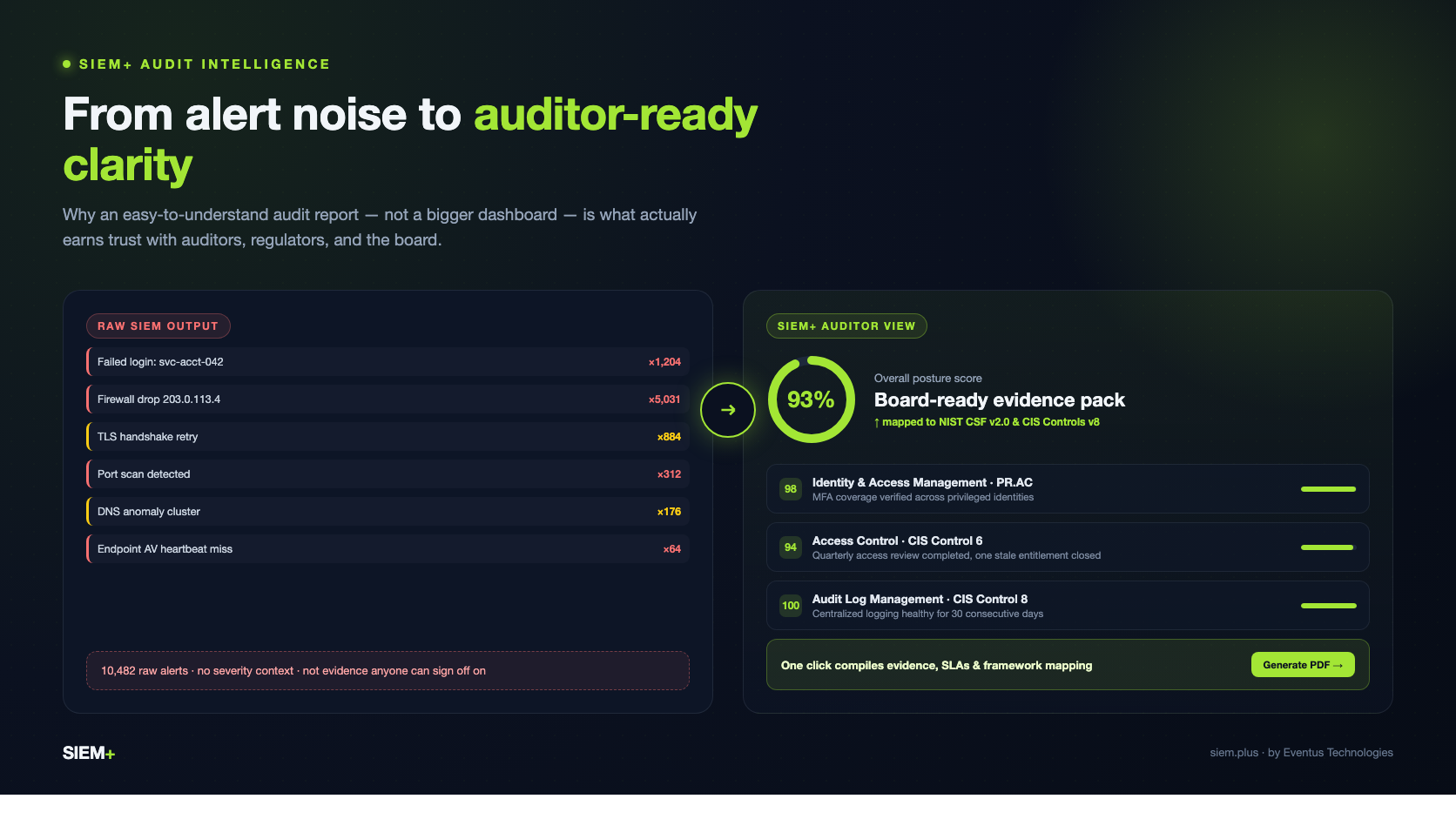
Before anything reaches the report, our AI engine performs Case Grouping — consolidating related alerts (a burst of failed logins followed by an MFA bypass, for example) into a single Case with a root cause, a timeline, and a severity. An auditor reading the report never sees "1,204 failed login events." They see one line: "MFA bypass detected and remediated for a single privileged account." That is a sentence a compliance officer can act on immediately.
2. A posture score that means something
Instead of a flat percentage with no explanation, every category — Identity & Access Management, Network Boundary, Continuous Monitoring, Audit Log Management — carries its own score, built from our penalty decay algorithm rather than a naive linear count of alerts. Critically, each score is paired with the evidence that produced it. Expand "Access Control · 94%" and you get the actual sentence: "Quarterly access review completed for all business units; one stale contractor entitlement remediated." No score in SIEM+ exists without a human-readable reason attached to it.
3. Framework mapping done automatically, not manually
Compliance teams have historically spent hours mapping internal controls to frameworks like NIST CSF v2.0 and CIS Controls v8 in a spreadsheet, by hand, every quarter. SIEM+ does this mapping continuously: each category in the report is tagged directly against the relevant control (PR.AC, DE.CM, Control 6, Control 8, and so on), so the auditor can trace a finding straight back to the framework clause they're checking against — no translation layer required.
4. Coverage gaps are called out, not hidden
An audit report that only shows good news isn't credible — and it isn't useful. If a category has no log coverage, SIEM+ flags it explicitly as unmonitored, in red, rather than silently omitting it or scoring it as if everything were fine. Auditors trust reports that show their own blind spots. Hiding a gap only guarantees the auditor finds it themselves, and finds it as a bigger problem than it actually is.
5. Operational proof, not just posture
Alongside the framework mapping, the report surfaces the metrics auditors actually ask for in interviews: Mean Time to First Response, total case volume, AI-automated triage rate, and percentage of critical/high cases closed within SLA. These are pulled live from case data over the trailing 30 days — not reconstructed from memory during the audit itself.
6. Continuous Heartbeat: proving the logs never stopped
A control that "exists" on paper but has a silent ingestion gap is worse than no control at all, because it creates false confidence. The Auditor View includes a Continuous Heartbeat timeline across Cloud/Identity, Network, and Endpoint sources, color-coded green/yellow/red for healthy, degraded, or gapped ingestion — down to the hour, for the last 24 hours, a specific day, or the last 30 days. This answers a question every auditor eventually asks — "how do I know you were actually watching?" — with a picture instead of a promise.
7. One click to a signed, board-ready PDF
None of this matters if it still takes a week to compile into something shareable. SIEM+ compiles the full posture score, framework mapping, evidence strings, and SLA metrics into a single PDF, on demand, in seconds. Every historical report is versioned and retrievable, so you can show an auditor not just today's posture, but the trend over time — with zero manual reassembly.
Why this matters commercially, not just technically
An audit report that a human can actually read and trust isn't a nice-to-have UI feature — it's a compliance accelerant. Teams using SIEM+ walk into SOC 2 renewals, ISO 27001 surveillance audits, and board reviews with a document already built, already mapped, and already defensible. That turns audit season from a multi-week fire drill into a five-minute export.
If your team is still stitching together screenshots, spreadsheets, and Slack threads every time an auditor asks "show me," it's worth seeing what a report that's audit-ready by default looks like.
See it on your own environment: siem.plus — or reach out to the Eventus team to talk through your next audit cycle.