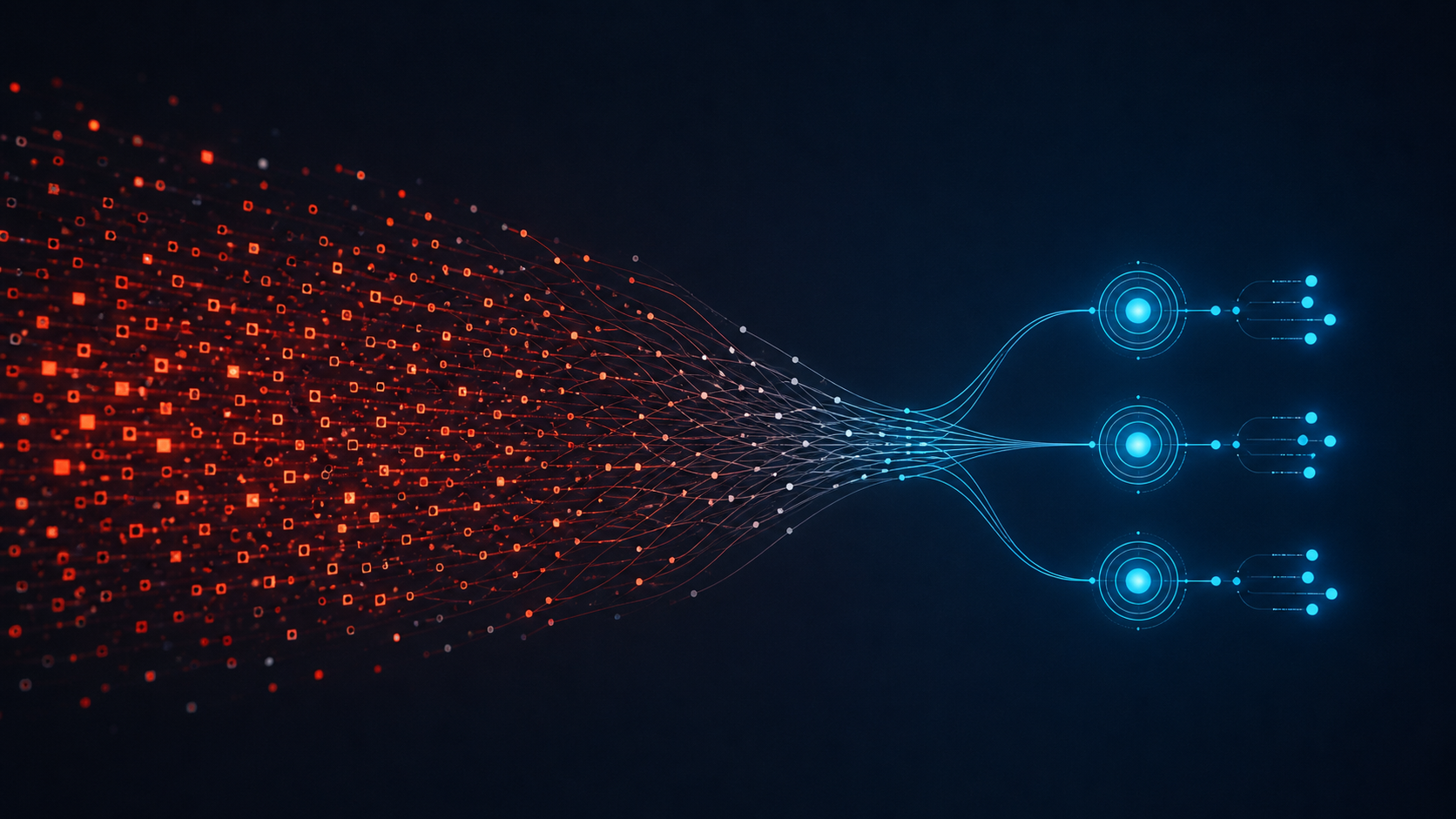
From 40,000 Alerts to Fewer Than 10 Cases a Day: What Alert Fatigue Really Costs Security Teams

Security teams are not short on alerts. They are short on time, context, and attention.
A 2025 survey of 2,058 security leaders found that 59% receive too many alerts, while 52% described their SOCs as overworked. Security Magazine’s summary of the research also found that many teams lose investigation time because their security data is difficult to manage and disconnected across tools.
The human cost is just as clear. In the 2025 ISC2 Cybersecurity Workforce Study, 48% of respondents said they felt exhausted from trying to keep up with new threats and technologies, while 47% felt overwhelmed by their workload. ISC2’s study surveyed more than 16,000 cybersecurity professionals and decision-makers.
This is alert fatigue: the point where every notification starts to look the same, every investigation feels urgent, and analysts have to spend more energy deciding what to ignore than determining what matters.
It is not a company-specific problem. It is an operational problem affecting security teams everywhere.
What SIEM noise looks like in practice
Alert fatigue is often discussed as if it simply means “too many alerts.” In practice, the problem is more complicated.
A single event can generate multiple notifications across different security systems. One suspicious login might appear as an identity alert, an endpoint alert, a cloud activity alert, and a network anomaly. Each notification may be technically valid, but none of them provides the complete picture.
Then there are the alerts that are difficult to interpret. They may contain a severity level, a timestamp, and a technical message, but not enough context to answer basic questions:
- Is this activity genuinely unusual?
- Has the same behavior already been reviewed?
- Is this connected to anything else happening in the environment?
- Does it require action now, or can it wait?
Low-signal notifications create the same problem. Routine administrative activity, known-safe behavior, and repeated background events can all compete for attention with a genuine security incident.
The result is not just a larger queue. It is a weaker triage process.
The 2026 SANS SOC Survey described the issue plainly: security operations practitioners are dealing with too many alerts that do not connect and not enough shared context to act on. In the survey, 24% of cyber leaders identified a lack of enterprise-wide visibility as the biggest barrier to effective security operations. SANS’ 2026 findings were based on responses from security operations professionals and senior security executives.
When analysts cannot quickly connect related activity, every alert becomes a separate task. That is where SIEM noise turns into real operational cost.
A real example: 40,000 alerts a day to fewer than 10 cases
One real SIEM+ customer was dealing with approximately 40,000 alerts per day.
After SIEM+ was introduced, that volume was reduced to fewer than 10 cases per day.
The point is not that the environment suddenly stopped producing security activity. The point is that the triage layer became better at separating repeated signals, expected activity, and meaningful risk.
The customer received a much smaller number of cases that represented actual investigative work. The qualitative outcome was straightforward: the team could focus on what mattered without feeling that something was falling through the cracks.
That distinction matters.
Reducing alert volume is not the same as reducing visibility. Suppressing everything may produce a quieter dashboard, but it does not produce better security. Effective SIEM noise reduction means making the remaining cases more useful, more understandable, and easier to prioritize.
What actually changed
At an outcome level, the change came from improving how alerts were evaluated before they reached the human investigation queue.
First, duplicate alerts were grouped together. Related notifications could be treated as one developing situation instead of several disconnected tasks. This reduced repetition without removing the underlying evidence.
Second, known-safe and known-bad activity could be handled more consistently. Activity that matched established patterns did not need to consume the same attention as something genuinely unusual. Clearly malicious signals could be prioritized instead of being lost in a larger stream.
Third, behavioral anomalies were considered in context. An event is not always risky simply because it is uncommon, and familiar activity is not always safe simply because it has happened before. Looking at behavior over time helps distinguish meaningful deviations from ordinary variation.
Finally, activity across related accounts and systems could be correlated. Instead of asking an analyst to manually connect separate alerts, the triage process could present a more complete view of the activity. That makes it easier to understand whether several events are part of one investigation or unrelated noise.
This is where AI security triage can be useful: not as a replacement for experienced analysts, but as a way to handle repetitive evaluation and organize the information that analysts need to make decisions.
The goal is a cleaner queue, better context, and more consistent outcomes.
The answer is not always more analysts
When an SOC is overwhelmed, the obvious response is often to hire more people.
Additional expertise can help, but headcount alone does not fix a triage process that sends every duplicate, low-signal, and poorly contextualized alert to a human. More analysts may simply create a larger team working through the same noise.
The better question is: what should reach an analyst in the first place?
Security teams need enough information to investigate real risk, but they do not need to manually reconstruct every connection between alerts. They should not have to spend most of their time translating cryptic messages, checking whether an alert is a duplicate, or deciding whether a familiar event is worth escalating.
That is why the triage layer matters so much. It sits between raw security activity and human decision-making. When it works well, analysts spend more time investigating meaningful cases and less time processing noise.
SIEM+ is designed for that layer. It works with any SIEM, so teams can improve alert handling without a rip-and-replace project or a complete redesign of their existing security environment.
The practical lesson from 40,000 alerts becoming fewer than 10 cases is simple: security operations do not always need more data or more dashboards. They need a better way to turn data into focused investigative work.
Book a 15-Minute Demo or View Pricing.