After the mid-Oct Fortinet advisory wave: why SIEM queues get louder

Around mid-October 2026, Fortinet PSIRT published a cluster of product security advisories across FortiOS, FortiSIEM, FortiSandbox, FortiManager, FortiAnalyzer, FortiMail, and related products. One widely noted item in that wave was FG-IR-26-181 / CVE-2026-106174: an improper locking issue in FortiOS that can let an unauthenticated network attacker deny service to the HTTPS management GUI on affected 8.0.0 and 7.6.4–7.6.6 builds.
For security teams that already run a SIEM, the interesting part is not any single CVE. It is what happens to the queue when a major vendor drops a dense advisory set in a short window.
What the mid-Oct wave looked like (vendor sources only)
On and around 13 October 2026, Fortinet PSIRT listed multiple new or updated advisories on the same day. Besides FG-IR-26-181, the public index included items such as:
- FG-IR-26-180 / CVE-2026-106173 — critical path-traversal issue in FortiSIEM (unauthenticated code/command execution on affected 7.5.0; FortiSIEM Cloud not affected per the advisory).
- FG-IR-26-182 / CVE-2026-106175 — double-free in FortiOS / FortiProxy / FortiSwitch CLI paths (local authenticated DoS).
- FG-IR-26-183 / CVE-2026-106176 — broken authorization in FortiSIEM GUI.
- FG-IR-26-179 / CVE-2026-106172 — Fabric API authentication bypass concerns in FortiSandbox / FortiSandbox Cloud.
- Additional same-day entries covering FortiSandbox GUI session issues, FortiAnalyzer / FortiManager SQL injection paths, FortiMail, and FortiManager command-injection fixes — all listed on the PSIRT advisories index.
A later critical third-party PHP core RCE packaging advisory (FG-IR-26-186, published ~21 October) kept the same pattern going into the following week: more CVEs to map, more version matrices to check, more “are we affected?” tickets.
None of this assumes your estate runs FortiGate or FortiSIEM. It is industry context from public vendor advisories: when a large infrastructure vendor ships a multi-product wave, operators everywhere feel the secondary effects in monitoring and change windows.
Why SIEM queues get louder after a vendor wave
Vendor PSIRT days create three concurrent loads for end-user security and IT teams:
- Inventory and exposure mapping. Which build of which appliance or appliance-adjacent product is in production? Which management plane is reachable? The advisory tables (affected vs fixed versions) become a spreadsheet exercise under time pressure.
- Patch-and-verify churn. Upgrades, virtual patches (FG-IR-26-181 notes a FortiGuard virtual patch in FMWP db update 26.073), config hardening, and post-change validation all generate tickets — and each change can itself produce new SIEM events.
- Detection and scanner noise. Vulnerability scanners, configuration monitors, IDS/IPS signatures, and firewall logs often spike as new checks land and as probes or opportunistic scanning follow public disclosure. The SIEM does its job: it records the activity. The human queue fills with near-duplicates, severity mismatches, and “is this our asset?” work.
The result is familiar: more alerts, more cases that look urgent, and less analyst time for the incidents that actually need a person.
The rip-and-replace trap
When queues swell, it is tempting to blame “the SIEM” and start a platform replacement conversation. That rarely helps in the week after a PSIRT wave.
Your SIEM already holds the retention, detection rules, and evidence trail you need for audit and investigation. Replacing it mid-incident-cycle does not shorten patch-verify work; it adds a multi-year migration while the noise continues.
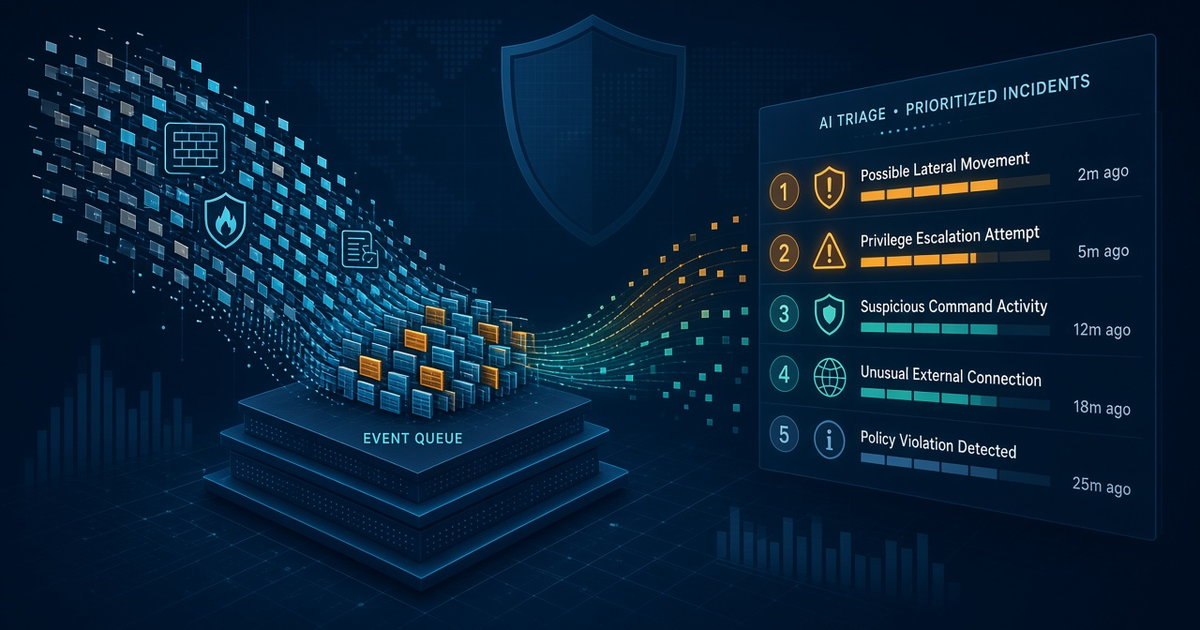
What helps in the short window is triage capacity: grouping related alerts, explaining what an advisory-driven spike means in plain language, and pointing analysts at verified next steps — without discarding the SIEM you already run.
Where an AI triage layer fits
SIEM+ is built as an AI layer on the SIEM you already operate (Microsoft Sentinel and Devo are examples only). It does not replace detection rules or the SIEM itself. Enterprise can support on-premises deployment when that is required.
In a mid-advisory-wave week, that layer is useful for end-user SOC and IT security teams because it can:
- Group related alerts into fewer prioritized incidents instead of leaving every scanner hit and firewall event as a separate ticket.
- Summarize in plain language so a generalist can tell advisory-driven noise from a real exploit attempt against a reachable management interface.
- Surface remediation guidance for human review aligned to the assets and cases already in the SIEM — useful when patch windows and verify steps compete for the same people.
- Keep audit-oriented trails so “what did we do after the mid-Oct wave?” is answerable later.
The point is not to ignore Fortinet (or any vendor) advisories. It is to keep the SIEM queue usable while people do the inventory, patch, and verify work the advisories require.
Practical takeaways for operators
- Treat a dense PSIRT day as an operations surge, not only a CVE reading list: expect louder firewall and SIEM queues for days after publication.
- Start from the vendor matrix (affected versions, workarounds, virtual patches) on FortiGuard PSIRT — for FG-IR-26-181 that means checking FortiOS 8.0.0 and 7.6.4–7.6.6 against fixed 8.0.1+ / 7.6.7+.
- Separate exposure (management plane reachable? product in scope?) from noise (scanner and signature chatter). Both land in the SIEM; only one set needs the same urgency.
- Prefer triage on top of the SIEM you have over a rip-and-replace discussion while the wave is still active.
Vendor advisory waves will keep coming. The teams that stay calm are the ones whose SIEM still produces a short, explainable case list when the rest of the industry’s dashboards turn red.
Sources (Fortinet PSIRT only): PSIRT advisories index; FG-IR-26-181 / CVE-2026-106174; FG-IR-26-180 / CVE-2026-106173; FG-IR-26-182 / CVE-2026-106175. Industry operational framing only — no claim that any reader’s estate is affected.
Product note: SIEM+ — AI alert triage on your existing SIEM; does not replace the SIEM or its detection rules.